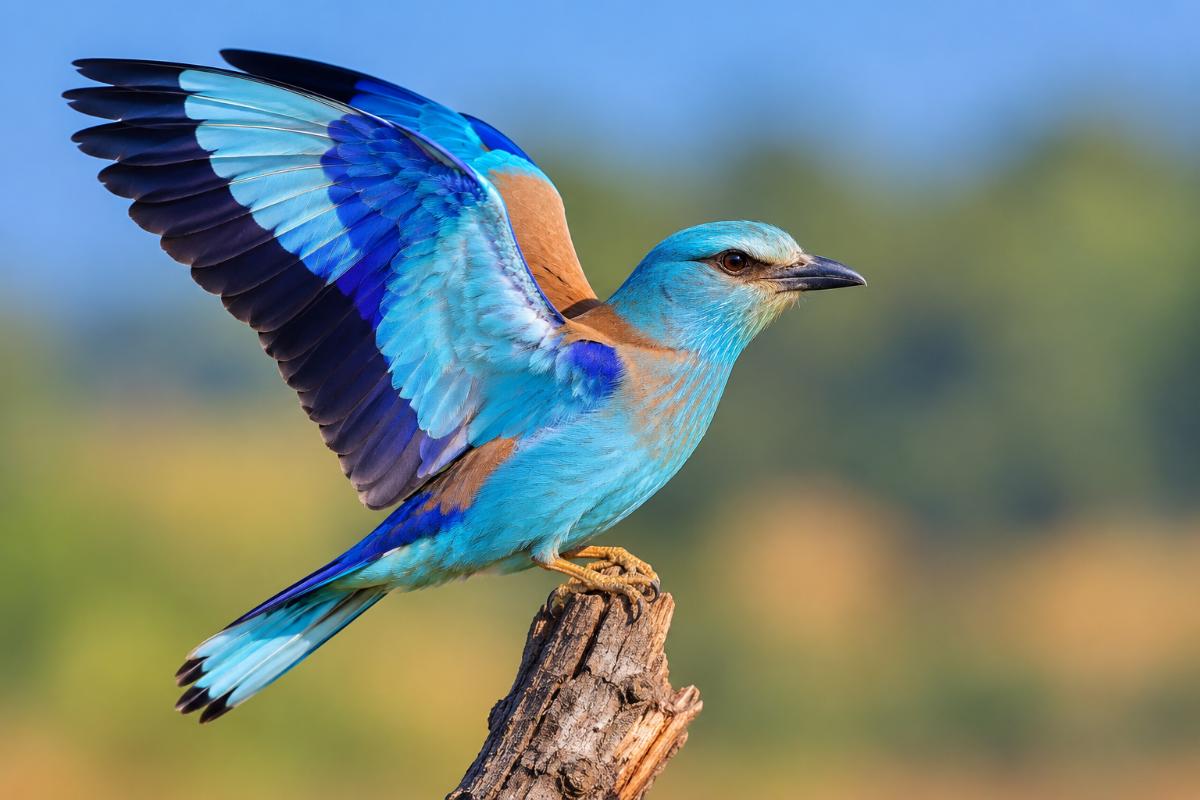

There is something special about seeing a European Roller.
It is not just the striking blue colour, the warm brown back, or the beautiful black-and-blue wings that flash when it takes off. There is something much bigger behind the sighting.
A European Roller sitting quietly on a roadside pole near Bengaluru may have already travelled thousands of kilometres.
And in recent weeks, birders around Bengaluru and other parts of Karnataka have been noticing and photographing these beautiful migrants more frequently.
So where have these birds come from? Why are they here now? And where will they go next?
The answer takes us far beyond Karnataka—to Central Asia, across the Indian subcontinent, over the Arabian Sea and eventually into Africa.
A visitor from thousands of kilometres away
The European Roller (Coracias garrulus) is a long-distance migratory bird that breeds across parts of Europe and Central Asia, including regions extending towards Kashmir.
Unlike some migratory birds that spend the winter in India, the European Roller is primarily a passage migrant through India.
Bird Count India describes the species as a true passage migrant through the Indian subcontinent. During the autumn migration, large numbers pass through northwestern and western India, while smaller numbers move through southern India. The autumn passage generally occurs from August to November.
That makes September and October particularly interesting months for birders in Karnataka.
The bird we see sitting on a pole, hunting insects in an open field, may simply be taking a break during an enormous journey.
The journey begins in Europe and Central Asia
When the breeding season ends, European Rollers begin moving south.
The exact route depends on the population, but the eastern populations have a remarkable migration system connecting Central Asia with Africa.
Recent tracking work has provided some fascinating clues.
BirdLife South Africa has been studying the migration of European Rollers using tiny tracking devices. In one project, tagged birds travelled north from southern Africa through Tanzania and Kenya, paused in Somalia, and then continued through Oman and India towards Central Asia.
Some of the tracked birds eventually reached Uzbekistan, while another reached China.
This is extraordinary when you consider the size of the bird and the distances involved. The entire migration can extend to around 10,000 kilometres.
For a birdwatcher in Bengaluru, that puts a completely different perspective on a Roller sighting.
It isn't simply "a rare bird at Hoskote."
It could be one small part of an international migration journey connecting Africa, the Arabian Peninsula, India and Central Asia.
So why does it come through India?
India sits directly within the migration pathway of the eastern population.
During autumn, Rollers move south from their breeding grounds. Some travel through northwestern and western India, while others continue further south through the peninsula.
Bird Count India's migration map shows European Rollers passing through India mainly between August and November. After crossing the Indian subcontinent, many continue towards Africa.
India therefore acts as an important geographical bridge in this enormous journey.
For the birds, the country also provides something very important:
food and places to rest.
Why Bengaluru?
This is where things become especially interesting for local birders.
Bengaluru is surrounded by a mixture of agricultural land, grassland, scrub, lakes and open countryside.
Areas around Hoskote, Devanahalli, Doddaballapur, Hesaraghatta, Jigani and other parts of the Bengaluru landscape contain many of the features that a passing Roller can use.
European Rollers are often seen from prominent perches such as:
- electric wires
- poles
- dead branches
- isolated trees
- fences
From these elevated positions, they scan the ground for insects and other prey.
After feeding, they may simply sit quietly for long periods.
That behaviour can make them surprisingly easy to spot—especially when the bright blue plumage catches the eye.
For a migrating bird, however, that quiet period is probably not wasted time.
It is a chance to feed, rest and build energy for the next stage of the journey.
Why are Bengaluru birders suddenly seeing so many?
This is a question many birders are asking.
There are probably several reasons.
1. It is migration season
September falls right in the middle of the autumn passage period.
So naturally, the number of Rollers moving through the region can increase during this period.
2. Bengaluru has a growing birding community
The number of people carrying cameras, joining WhatsApp birding groups and uploading observations to eBird has grown enormously.
A bird that might once have been seen by one person and recorded in a notebook can now be photographed and shared with hundreds of birders within minutes.
3. Social media makes rare birds look common
This is an interesting phenomenon.
Suppose ten birders independently find the same Roller.
On WhatsApp and Facebook, it may look like ten different Rollers.
Sometimes it is.
Sometimes it is the same individual being photographed repeatedly.
Therefore, a sudden increase in photographs does not automatically mean that the population has suddenly increased.
It tells us that the bird is being noticed and documented more effectively.
But European Rollers have been visiting southern India before
The current sightings should not be interpreted as though European Rollers have suddenly discovered Bengaluru.
The species has been recorded in southern India in the past.
What has changed dramatically is our ability to observe and share those records.
Citizen-science platforms such as eBird have created a much larger record of bird movements than was possible in the past.
The State of India's Birds lists European Roller as a passage migrant and localized summer migrant in Karnataka. However, it also notes that the long-term trend in Karnataka is currently insufficiently known.
At the national level, the 2025 update currently categorizes the species' annual trend in India as declining, although the long-term trend remains insufficiently known.
So it would be premature to say that European Rollers are definitely increasing in Karnataka simply because more photographs are appearing this year.
More observations are valuable precisely because they can help us understand whether the birds are actually becoming more numerous or whether we are simply becoming better at finding them.
The most fascinating part: where does it go next?
This is perhaps the best question to ask when you see a European Roller in Bengaluru.
Imagine the bird sitting on a pole in Hoskote today.
After feeding and resting, it may continue south or southwest.
Eventually, it can leave India and cross the Arabian Sea.
On the other side is Africa.
The species spends its winter in Africa, and tracking work has now revealed some of the remarkable connections between its African wintering grounds and its Central Asian breeding grounds.
So that beautiful blue bird photographed in Karnataka could eventually be thousands of kilometres away in Africa.
And next spring, the journey happens again in the opposite direction.
It doesn't simply turn around and come back
Migration isn't always a simple journey along the same road in reverse.
Bird Count India's migration information indicates that European Rollers use different broad routes during their annual movements. In spring, the species largely returns towards its breeding grounds through the Arabian Peninsula.
This is one reason migration is so fascinating.
Birds are not following an imaginary straight line drawn on a map.
They are responding to geography, weather, food availability, winds, ecological conditions and evolutionary history.
A Bengaluru Roller is part of a much bigger story
The next time someone posts:
"European Roller spotted near Hoskote!"
it is worth pausing for a moment.
That bird could have started its journey somewhere in Central Asia.
It may have crossed several countries.
It may have travelled across thousands of kilometres.
It may have stopped in different landscapes to feed and recover.
It may soon cross the Arabian Sea.
And eventually, it could spend the winter in Africa.
Then, months later, it will begin the long journey north again.
All of this is happening while the bird appears to be doing something very simple:
sitting quietly on a pole and looking for insects.
Bengaluru is only one small stop on the map
Perhaps that is what makes the recent European Roller sightings around Bengaluru so exciting.
We often look at a bird sighting as a local event:
"I saw a European Roller today."
But migration allows us to see it differently.
It is not just a Bengaluru bird.
It is not just an Indian bird.
It is part of a migration network connecting Europe, Central Asia, India, the Arabian Peninsula and Africa.
Every sighting contributes another small piece to our understanding of that journey.
And with more Bengaluru birders photographing, recording and uploading their observations, we may gradually learn more about how these remarkable travellers use our city and its surrounding landscapes.
So, the next time you see that flash of brilliant blue over a dry field, don't just think:
"European Roller!"
Think:
"How far has this little traveller already come—and how much farther does it still have to go?"
The journey in one line
Central Asia / Europe → India → Arabian Sea → Africa → back north again
A tiny blue bird.
A journey spanning continents.
And Bengaluru happens to be one of the places where we get a chance to watch the journey unfold.

💬 Comments (0)
Sign in to leave a comment
No comments yet. Be the first to share your thoughts!